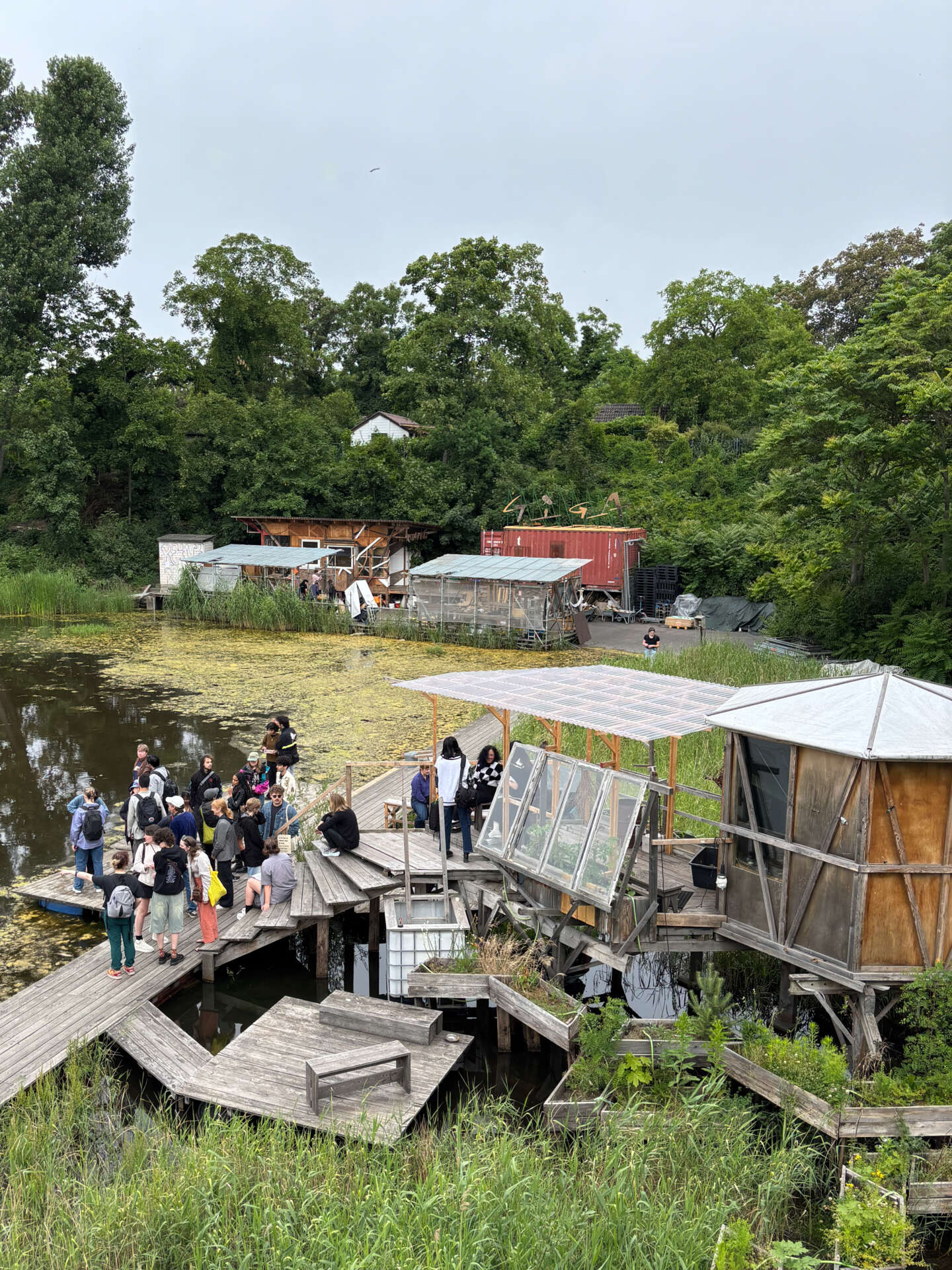
Designing the Process, Designing the Space Self-generative Spaces for More-than-human Communities
Abstract
The paper investigates how spatial and processual dimensions of urban public spaces co-produce each other, using the Floating University in Berlin as a case study. Conventional approaches in public space design typically work with the establishment of fixed spatial configurations, disconnected from ongoing social and ecological processes. In contrast, this text argues for a shift toward viewing design as continuous engagement with social practices, ecological rhythms, and everyday maintenance. At the Floating University, spaces evolve iteratively through collaborative actions involving diverse participants, including local communities, maintenance groups, and ecological agents. Designing the process means actively shaping participatory structures, decision-making systems, and maintenance routines that influence spatial outcomes. Concurrently, designing the space involves creating frameworks flexible enough to accommodate ecological variability and collective practices. By integrating spatial and processual perspectives, the Floating University demonstrates that urban public spaces can be read as dynamic systems, continuously reshaped through collective and ecological interaction rather than fixed architectural artifacts.
Keywords: process-oriented design, spatial co-production, more-than-human communities