Designing the Process, Designing the Space Self-generative Spaces for More-than-human Communities
To understand the relationship between urban public spaces and biodiversity, it is not enough to think in terms of the design of the space. It is equally necessary to consider the design of the process – the ongoing practices, negotiations, and transformations that shape and sustain these spaces over time.
While spatial design traditionally refers to the configuration of physical forms, process design involves the ways in which spaces are initiated, inhabited, adapted, and maintained. In urban environments, especially those where ecological and social systems intersect, these two dimensions are deeply intertwined. Space is not simply a backdrop for action; it is co-produced by the living, material, and institutional processes that unfold within it.
This paper explores the entanglement of process and spatial design through the lens of relationality, assemblage theory and the notion of process-oriented design. These frameworks help to reframe urban public spaces as open-ended and continuously reconfigured by multispecies interactions and ecological rhythms.
To ground this inquiry, the paper focuses on the Floating University in Berlin, a site where more-than-human life, collective maintenance, and adaptive reuse converge. Drawing on fieldwork and theoretical reflection, the case study illustrates how spatial form and ongoing processes co-constitute one another, offering a model for understanding public spaces as living systems – flexible and shaped by both human and nonhuman actors.
On process design and spatial design
The design of public spaces is often approached as the shaping of physical form. Materials, volumes, circulation, and program are drawn and defined, rendered and built. Yet in spaces where life is constantly unfolding – where people gather, species interact, seasons shift, and maintenance routines take shape – the role of design becomes something else. In these contexts, spatial form does not precede use. It is produced, adapted, and redefined through use. Space emerges with time, through gestures, responses, and negotiations that are both human and more-than-human. Here, spatial design and process design are no longer separable.
To work with space in this way is to engage with it reflectively, not as an abstract object but as a dynamic situation. Design becomes a practice of careful listening, of testing, of returning – what has been described as a “reflective conversation with the situation” (Schön 1992). Each intervention generates a response, and each response reshapes what the space becomes. This kind of conversation doesn’t end at the moment of construction. It continues as people inhabit the space, as plants spread, as maintenance practices evolve.
In these public settings, social and ecological interactions are shaped by the spatial framework, but never dictated by it. The presence of neighbors chatting across hedges or pausing along a path is not simply the outcome of good form – it is the result of a supportive interplay between physical possibilities and lived processes (Gehl 2011). Design can open up this spectrum of possibilities – or it can restrict it entirely. It can either block or support the kinds of interactions, adaptations, and relationships that allow public spaces to remain alive.
The more a space is used, the more it changes. Social activity, ecological rhythms, and even informal interventions by users push against the edges of what was planned. A garden may spread beyond its original boundary. A footpath may emerge where none was intended. A gathering may grow into a weekly ritual. These are not exceptions to design but part of the design process itself – if the process is understood as open-ended and relational.
This requires letting go of the idea of control. Rather than finalizing form, designers working in these contexts often engage in setting up conditions – conditions that make it possible for something to happen, without deciding exactly what that something must be. The role of design becomes less about defining outcomes and more about holding open certain relationships, certain affordances. That means attending not just to program or layout, but to cycles, edges, tolerances, and patterns of use that can evolve with time (Till 2009; Karami 2022).
Bruno Latour and Albena Yaneva (2017) further support this relational perspective by challenging the idea of architectural stability. Rather than perceiving spaces as fixed, completed structures, they propose understanding architecture as continually moving and evolving – subject to constant processes of transformation, adaptation, and negotiation. This perspective aligns closely with the conception of public spaces as dynamic assemblages discussed here, emphasizing that urban environments are never finished objects.
When designing the process, we are already shaping the space. Decisions about who participates, how decisions are made, which maintenance rituals are established, and what types of temporalities are allowed – all of these leave spatial traces. They guide the formation of paths, the density of vegetation, the layering of use. The way a process unfolds will inscribe itself into the materiality of the site. This means that spatial design does not follow process design, nor does it precede it. They co-produce one another.
Likewise, the spatial configuration – how open, modular, accessible, or constrained it is – affects the kinds of processes that are possible. A locked gate, a fixed bench, a sloped terrain – each of these may enable certain actions and inhibit others. In this sense, designing space is designing the conditions for a process to take place, just as designing the process sets the parameters through which space can emerge. Their relationship is recursive, not sequential.
Thinking in this way also expands who and what is considered a participant in shaping space. The air and water that pass through a site, the materials that decay or erode, the species that settle or depart – these are all part of the process. Urban biodiversity is not something that is simply added into a design; it is a spatial force in its own right, shaping paths and thresholds through the movement of nutrients, pollinators, water, and seeds (Lepczyk et al. 2017). To design for biodiversity means designing with these forces, not just around them.
In turn, this demands a more situated and collective understanding of knowledge. No single actor can grasp the full complexity of how a space changes through use and time. What matters are the plural perspectives, embodied practices, and small adjustments that accumulate into a shared transformation of space. This is a knowledge of the many, emerging not from abstract expertise but from doing, maintaining, experimenting, and paying attention (Persyn et al. 2021).
What holds these spaces together is not a single narrative, but a kind of assemblage – a loosely coordinated, continually shifting constellation of relations (Tsing 2020). These assemblages are not designed in the traditional sense, but they are not accidental either. They are shaped through iteration, through care, through the accumulation of situated actions and decisions.
Crucially, this perspective recognizes that public space is never neutral. It is full of politics, affordances, exclusions, and invitations. Design can facilitate interaction, or it can block it entirely. It can allow cohabitation, or force displacement. It can make space for uncertainty, or try to erase it. Rather than resolving these tensions, process-aware design works within them – holding space open long enough for others to participate in its becoming (Escobar 2018; Wigley 2017).
When spatial and process design are treated as interdependent, public spaces begin to act more like living systems than finished projects. They adapt, they age, they respond. And in doing so, they offer something that static design cannot: the capacity to remain relevant, inhabited, and meaningful over time.
Floating University
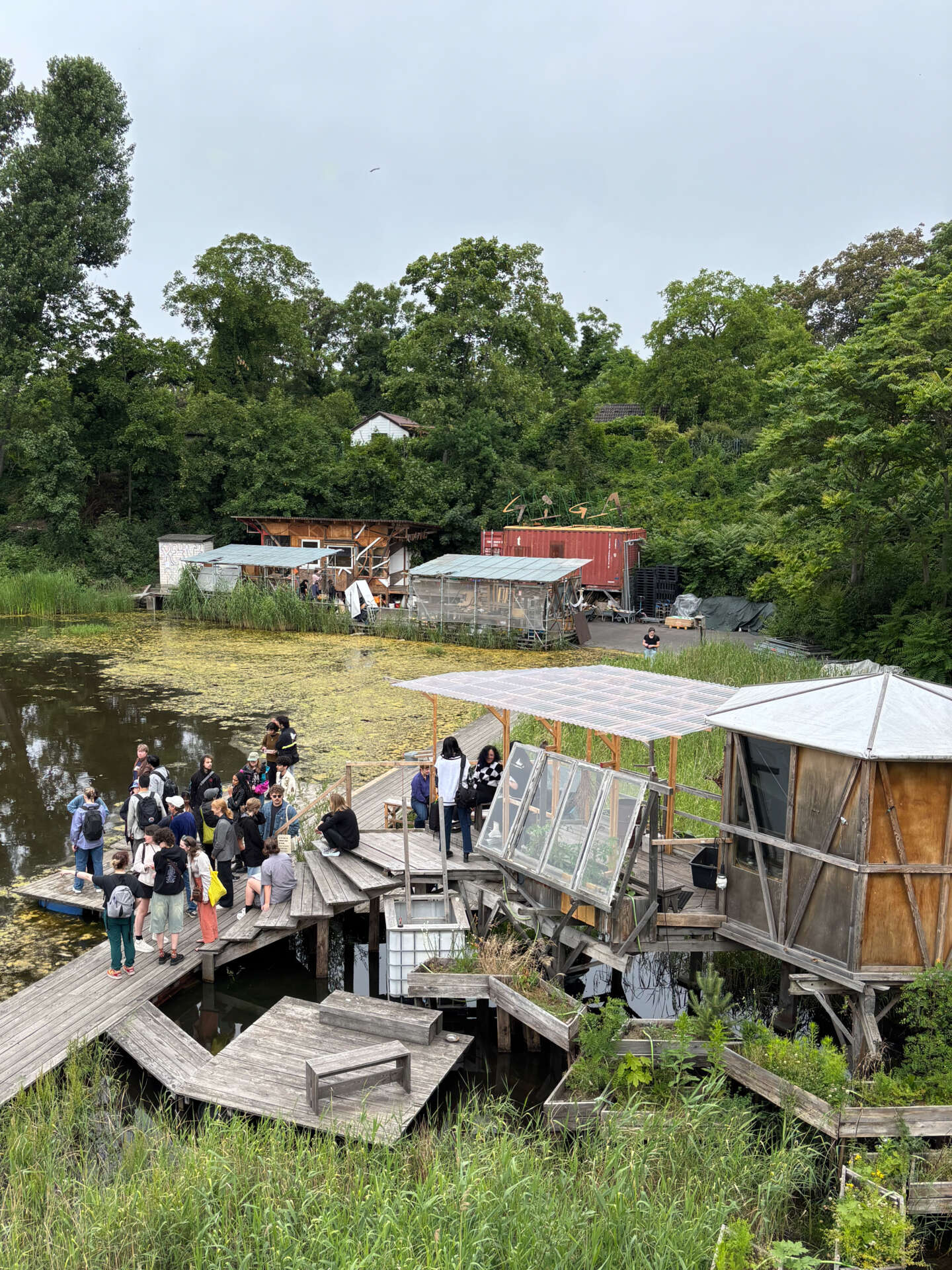
The Floating University in Berlin exemplifies precisely this relational and processual understanding of public space. Initiated in 2018 by the architecture collective Raumlabor, the project occupies a former rainwater retention basin, previously inaccessible and overlooked. Rather than erasing its existing ecological and infrastructural characteristics, the design embraces them as integral conditions for collective life, experimentation, and multispecies cohabitation.
From its inception, the Floating University was understood not as a finalized architectural statement but as a spatial framework inviting interaction, adaptation, and ongoing transformation. Its physical structures – built from scaffolding, reclaimed materials, and modular components – are deliberately unfinished, inviting continuous intervention and incremental growth. Paths, platforms, gathering spaces, and experimental installations remain flexible and reconfigurable, shifting according to seasonal cycles, community needs, and ecological dynamics.
The ecological dimension of the site is not simply background scenery or decoration – it is an active participant in shaping the space. One vital ecological process is performed by reeds (Phragmites australis), which naturally purify the rainwater collected in the basin. These reeds are not just passive elements but actively facilitate access and use, enabling both human and nonhuman actors to engage with the site. This natural process illustrates clearly how ecological systems actively shape spatial design and influence patterns of use, demonstrating that biodiversity is integral to urban spatial processes (Lepczyk et al. 2017).
Maintenance practices at the Floating University intertwine ecological stewardship, educational activities, and social engagement. Consider again the cutting of reeds: an ostensibly routine maintenance task becomes a collaborative event involving university students, neighbors, ecologists, artists, and activists. This collective action transcends mere upkeep, becoming a form of co-design that addresses ecological, social, and educational needs simultaneously (Di Prete et al. 2021). Through these collective practices, maintenance emerges as an iterative form of design, adapting the space in response to the evolving demands of its diverse actors – human and more-than-human alike.
Educational and community activities at Floating University further emphasize this interconnectedness. Workshops held at the main pavilion – a repurposed structure initially designed by Atelier Bow-Wow for the 2015 exhibition Wohnungsfrage in Berlin – highlight adaptive reuse as an essential design principle. Originally conceived as a prototype for student housing, the pavilion now serves as the central hub for gatherings, workshops, and experimental activities. Its transformation underscores the inseparability of spatial design from the actors and processes that sustain it. Spatial form evolves continuously, responding to shifting ecological conditions, social dynamics, and practical needs.
In this context, Floating University exemplifies how public spaces can be designed and understood relationally and dynamically. Spatial transformations here cannot be fully grasped without recognizing the ongoing processes that define them. Maintenance, ecological rhythms, and adaptive reuse become forms of spatial co-production – collaborative, iterative processes that continuously redefine the site. This approach demonstrates that adaptability and responsiveness in public spaces emerge from their openness to ongoing transformation, interaction, and relational dynamics.
At Floating University, spatial and ecological transformations are inseparable. The reeds that purify water, the collaborative maintenance events, the workshops that foster collective learning, and the adaptive reuse of architectural elements all contribute to an understanding of the site as a continuous process rather than a fixed object.
By embracing this more-than-human perspective, designers and planners have the opportunity to move beyond static, human-centered approaches. Recognizing public spaces as open-ended and dynamic systems requires integrating the design of processes with spatial form, ensuring adaptability and responsiveness to ever-changing urban conditions. Floating University thus reveals public space not merely as physical territory but as a living system – a relational assemblage whose value lies precisely in its capacity to evolve, remain relevant, and sustain collective and ecological life over time.
Conclusion
Rethinking the design of public spaces through the lens of relationality and dynamic processes expands the conventional boundaries of architectural and urban practice. As demonstrated through the analysis of the Floating University Berlin, this approach moves beyond fixed spatial definitions, highlighting how spaces emerge continuously from interactions among ecological, social, and material actors. In this perspective, design is neither limited to the act of initial construction nor confined to human-centered decisions; rather, it extends into practices conventionally seen as maintenance, stewardship, or informal adaptation. These practices become integral mechanisms through which spatial qualities and ecological conditions mutually inform and transform one another.
The case of Floating University further demonstrates that the continuous interplay of ecological processes – such as the purifying action of reeds – and collective human interventions reshapes both the physical space and its potential uses over time. Spatial configuration is thus inseparable from the processes that sustain it, emphasizing the necessity of a design approach attuned to evolving conditions and multispecies relationships. Through iterative, reflective, and situated practices, the boundaries between process and spatial form become increasingly porous, revealing public spaces as ongoing assemblages rather than completed artifacts.
In recognizing these complexities, urban designers and planners are compelled to integrate ecological literacy and participatory engagement directly into their methods. Rather than merely providing frameworks for use, this demands attention to the conditions that facilitate or inhibit relational processes, both ecological and social. This shift offers pathways toward more resilient urban spaces, capable of adapting to ecological variability and diverse social practices, thereby sustaining their functionality and significance in rapidly changing urban contexts.
Figure 1: Floating University’s spatial configuration is not pre-determined by one single design action but rather by several ongoing processes: activities with local community, resources availability, life cycles of non-human species, and more. The space is in constant transformation and therefore more capable to stage unplanned and unexpected events. (Photo by the author taken on 14-06-2024).
Funder
Project funded under the National Recovery and Resilience Plan (NRRP), Mission 4 Component 2 Investment 1.4 - Call for tender No. 3138 of 16 December 2021, rectified by Decree n. 3175 of 18 December 2021 of Italian Ministry of University and Research funded by the European Union – NextGenerationEU. Project code CN_00000033, Concession Decree No. 1034 of 17 June 2022 adopted by the Italian Ministry of University and Research, CUP: D43C22001250001, Project title “National Biodiversity Future Center - NBFC”.
Literature
Di Prete, Barbara, Agnese Rebaglio, Davide Crippa, Leopoldo Ivan Bargna, Giovanna Santanera, and Leone Michelini. 2021. “Design for Urban Regeneration: Future Scenarios and Common Challenges in a Multispecies World for Synergistic Action-Research Between Design and Anthropology.” In From Human-centered to More-than-Human-Design, edited by Barbara Camocini and Francesca Vergani, 28–61. Milano: Franco Angeli Edizioni.
Escobar, Arturo. 2018. “Design for Transitions.” In Designs for the Pluriverse: Radical Interdependence, Autonomy, and the Making of Worlds. Durham: Duke University Press.
Gehl, Jan. 2011. “Processes and Projects.” In Life Between Buildings: Using Public Space, 93–108. Washington DC: Island Press.
Karami, Sepideh. 2022. “Starting from the Mess: The ‘Environment-Worlds’ of Architectural Research and Design.” In The Hybrid Practitioner: Building, Teaching, Researching Architecture, edited by Caroline Voet, Els Schreurs, and Helen Thomas, 201–211. Leuven: Leuven University Press.
Latour, Bruno, and Albena Yaneva. 2017. “«Give Me a Gun and I Will Make All Buildings Move»: An ANT’s View of Architecture.” Ardeth 1: 103–111.
Lepczyk, Christopher A., Myla F. J. Aronson, Karl L. Evans, Mark A. Goddard, Susannah B. Lerman, J. Scott MacIvor, Charles H. Nilon, and Timothy Vargo. 2017. “Biodiversity in the City: Fundamental Questions for Understanding the Ecology of Urban Green Spaces for Biodiversity Conservation.” BioScience 67 (9): 799–807. https://doi.org/10.1093/biosci/bix079
Persyn, Freek, Seppe De Blust, and Charlotte Schaeben. 2021. “Knowledge of the Many.” In Design in Dialogue: 51N4E, endeavour, Denkstatt, edited by Gediminas Urbonas, Ann Lui, and Lucas Freeman, 28–34. Berlin: Ruby Press.
Schön, Donald A. 1992. “Design as a Reflective Conversation with the Situation.” In The Reflective Practitioner. London: Routledge.
Till, Jeremy. 2009. “Architectural Agency.” In Architecture Depends, 153–170. MIT Press.
Tsing, Anna. 2020. “When the Things We Study Respond to Each Other: Tools for Unpacking ‘the Material’.” In More-than-human, edited by Andrés Jaque, Marina Otero Verzier, and Lucia Pietroiusti. Rotterdam: Het Nieuwe Instituut.
Wigley, Mark. 2017. “How Will We Separate? Propositions on the Future of Urban Space.” In Public Space? Lost and Found, edited by Gediminas Urbonas, Ann Lui, and Lucas Freeman, 79–83. Cambridge: SA+P Press.